Battery
Consider it for supported essential circuits and daily energy management. It does not burn fuel on site, but it still has equipment, siting and maintenance requirements. Plan how it will recharge.

JEMIR ENERGY / YOUR QUESTIONS, ANSWERED
A clearer picture of backup power, from the circuits you care about to the questions worth asking before installation.
Start anywhere. Explore ten topics, open the questions that matter to you, and bring the rest to a conversation.
Find your question ↓Ontario first. Regional and model-specific details are confirmed for your project.
Reviewed 26 October 2026.
01 / Your home & essential loads
Start with the everyday things an outage interrupts, then decide which ones matter most to you. A useful backup plan names the circuits it can support and the loads you would leave off.
For a well or sump pump, bring the motor model and starting requirements. A pump needs enough power to start as well as energy to keep cycling.
Refrigeration and essential lighting are common priorities. Record how often appliances run rather than assuming every nameplate load runs continuously.
Include your modem, router, computer and charging needs. Powering your equipment cannot guarantee that your internet provider stays online.
Heating, cooling, cooking and vehicle charging need a separate sizing discussion. A whole-home connection does not mean every appliance can run together.
That depends on the system and the loads you want to run. Capacity, power output and installation design need to be assessed for your property. A specialist will confirm which circuits and appliances can be supported.
We welcome homeowner enquiries across Canada. Share your location so the team can confirm service availability, installation arrangements and next steps.
02 / Ontario outage planning
Ontario has experienced significant storm damage. Hydro One’s June 2025 recovery update describes widespread damage from that spring’s ice storm. It is a real local reminder to plan, not a prediction of how often your own home will lose power.
Use your utility’s outage information and your household’s experience: which seasons cause problems, how long previous interruptions lasted, and whether you can stay elsewhere during a prolonged outage. A map’s restoration estimate is not a battery runtime target or guarantee.
“Which essential loads could this design support through the outage scenario I care about—and what is the plan if the battery runs out?”
Hydro One: Ontario ice-storm recovery, 16 June 2025 · Hydro One outage informationChecked 26 October 2026.
Back to topic index ↑03 / During & after an outage
A backup-capable installation needs coordinated battery, inverter and isolation equipment. The approved design determines which circuits receive backup power.
Do not assume every device will ride through a transfer without restarting. Transfer behaviour depends on the exact equipment, configuration and connected load; sensitive equipment may need its own UPS.
Fox ESS: FOX HUB G2 datasheet, v1.9, 1 September 2025 · ESA: energy storage system approvalChecked 26 October 2026.
Back to topic index ↑04 / Power, capacity & runtime
Can the system run the selected appliances together and handle motor starting demand?
How much usable energy is available for those appliances before recharging?
A first-pass runtime estimate divides energy available for backup by average load. It is only a starting point: conversion losses, reserve, temperature, appliance cycling and starting surges still need to be accounted for. An annual electricity bill alone cannot establish a pump’s surge demand or an exact outage runtime.
Ask for a written load list, simultaneous-load limit and realistic short- and longer-outage scenarios. Keep the assumptions beside the estimate.
U.S. Department of Energy: storage fundamentalsChecked 26 October 2026.
kW describes power: the rate of electricity delivery. kWh describes energy stored or used over time. A system must have suitable power for the loads you want to run and enough usable energy for the intended duration. See the backup guide.
There is no single runtime for every home. Starting charge, usable capacity, running loads, losses, temperature and operating settings all matter. Ask for scenarios using your loads and clearly stated assumptions, rather than a universal hours-of-backup claim.
Not automatically. Output depends on the inverter and the supported battery configuration as well as stored energy. Confirm both usable capacity and backup output for the exact system in your proposal.
05 / PowerQ, HUB & warranty
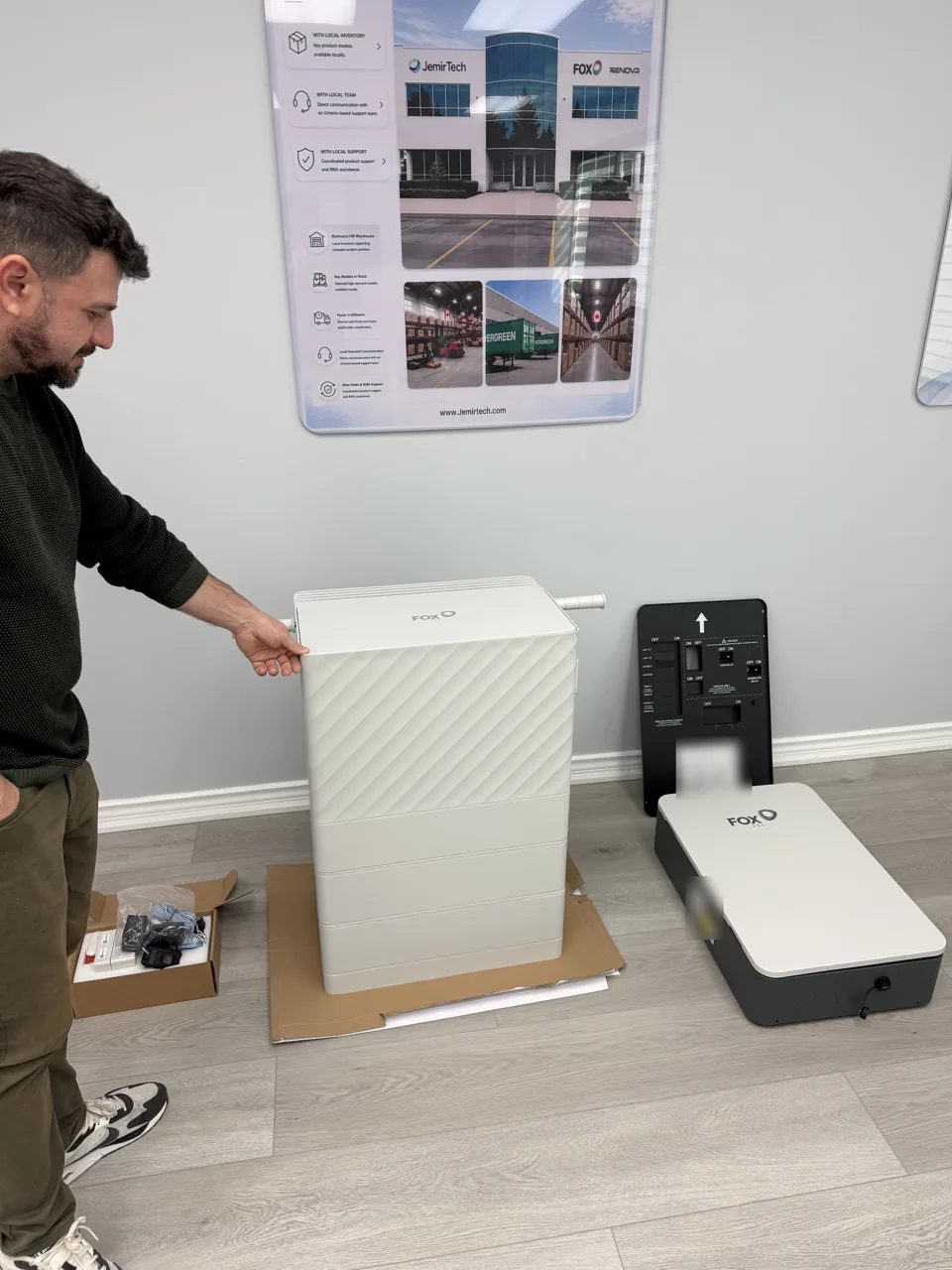
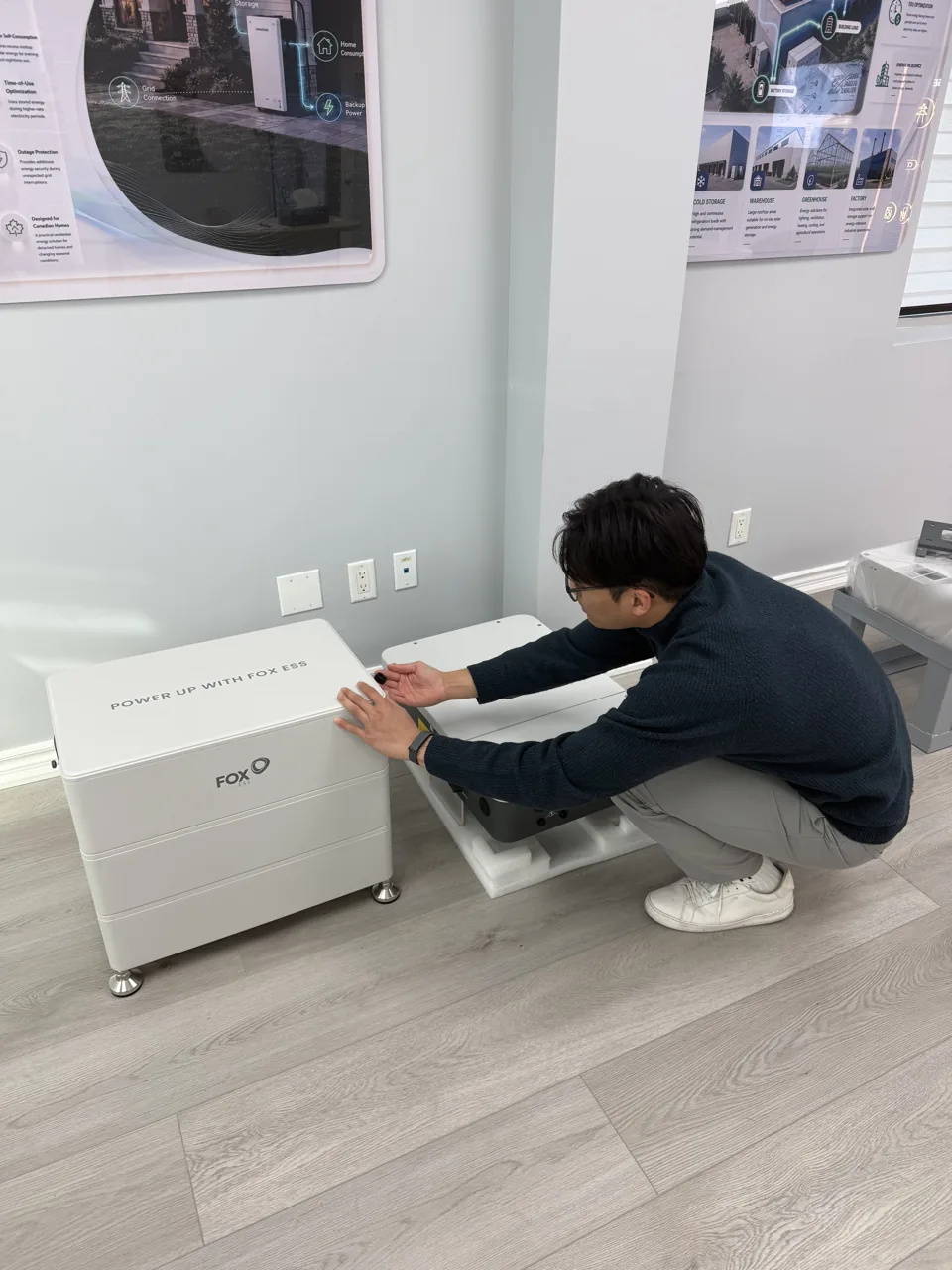
Jemir’s system overview introduces Fox ESS PowerQ and compatible FOX HUB G2 backup controls. PowerQ provides the battery/inverter system; the HUB manages connections and backup switching. A showroom display helps you understand the hardware, but the equipment list for your home must name the actual models and configuration.
The manufacturer’s HUB G2 datasheet describes grid transition, load management and generator integration. Those functions are subject to compatible equipment and design. A regional datasheet is not, by itself, proof that every listed configuration is approved for your Canadian home.
Before purchase, request the exact model datasheets, approved system combination, installation limits and written warranty applicable to your Canadian installation. Check the warranty period, capacity or throughput conditions, exclusions, registration, labour and who handles a claim. We do not substitute a global warranty headline for those terms.
Fox ESS: FOX HUB G2 datasheet, v1.9, 1 September 2025 · ESA: energy storage system approvalChecked 26 October 2026.
No. FOX HUB G2 is an energy management and backup-switching panel used with compatible equipment. Battery storage and inverter components are separate parts of the overall system. Read the system overview.
No. Exact model suffixes, regional electrical requirements and compatible equipment matter. Ask for the documents for the system proposed for your Canadian property; a global catalogue listing alone is not confirmation.
Request the warranty documents for the exact equipment and confirmation of who handles service. Coverage, exclusions, labour, capacity terms and claims procedures should be reviewed before purchase. Manufacturer warranty terms apply; ask the team to confirm coverage with your quote.
Suitability depends on the exact model, its charging and discharging limits, installation location and local conditions. An operating-temperature headline is not a guarantee of charging performance at that temperature. Ask for the relevant regional documents and siting advice.
06 / Comparing battery options
A brand name or large capacity number does not tell you how a system will perform in your home. Ask each supplier to answer the same practical questions, using the exact Canadian models proposed.
Continuous backup power, motor starting capability and which circuits are included.
Usable capacity, reserve settings, cold-weather limits and any conditions on future expansion.
Panel work, transfer equipment, existing solar or generator compatibility and monitoring requirements.
Written warranty, labour responsibilities, maintenance instructions and a clear service contact.
Keep backup performance separate from bill-savings projections. Compare the same loads, rate plan and assumptions; do not treat one manufacturer’s peak rating as another’s continuous output.
With a suitable rate plan and configuration, a battery can charge during lower-priced periods and supply selected household use later. Charging losses, backup reserve and ownership costs affect the result.
It may help on a suitable time-of-use plan, but savings are not guaranteed. Rates, usage, battery losses, capacity and equipment costs all matter. The Quick Savings Estimate uses Ontario-rate assumptions; it is not a personalised quote or a nationwide prediction.
They can be goals of the same suitable system, but there is a trade-off. Keeping more energy available for an outage may leave less available for daily rate shifting. Ask the specialist to explain the proposed operating reserve and priorities.
07 / Battery, generator or both
A battery stores a finite amount of energy. A fuel-powered generator produces electricity while fuel and operating conditions allow. Neither makes every load or outage duration a given.
Discuss the trade-offs in our battery versus generator comparison. FOX HUB G2 lists generator integration, but compatibility for the actual generator must be confirmed.
Fox ESS: FOX HUB G2 datasheet, v1.9, 1 September 2025Checked 26 October 2026.
Back to topic index ↑08 / Ontario incentive eligibility
Ontario: the Home Renovation Savings program’s battery incentive requires storage paired with a new solar PV system, sized for that system and primarily storing its solar generation. A standalone, grid-charged backup battery does not qualify under this solar-and-storage route.
The program describes load-displacement projects rather than net metering: participating projects cannot also use a net-metering agreement. Written program and local utility pre-approvals are required before purchasing or installing equipment. Homeowner, property and equipment eligibility also apply.
Adding a battery to existing solar is a separate technical question; do not assume that retrofit qualifies for this incentive. Confirm the current rules with the program before committing to a project.
Outside Ontario: these rules do not establish eligibility in Quebec or any other province. Ask about the current program for your location; we do not promise a rebate.
Ontario Home Renovation Savings: solar and storage eligibilityChecked 26 October 2026.
Back to topic index ↑09 / Adding to existing solar
Sometimes, but compatibility needs a design review. Bring the existing inverter and panel models, system drawings if available, and your utility agreement.
Ask specifically about charging during an outage, system restart after a depleted battery, export controls and the effect on existing warranties or utility agreements. Ordinary grid-connected solar alone should not be assumed to provide outage power. Adding storage does not automatically make every solar system backup-capable.
NREL: AC/DC coupling architecture, 2021 · ESA: energy storage system approvalChecked 26 October 2026.
Back to topic index ↑10 / Preparing for your project
Start with your location, the loads you care about and a recent electricity bill if you want to discuss usage. Include pump, heating or cooling model details, and tell us about existing solar or a generator. A virtual conversation offers preliminary guidance; it cannot certify panel compatibility.
ESA: notifications and inspectionsChecked 26 October 2026.
Prefer to see the equipment first? Arrange a Richmond Hill showroom visit. Visits are by appointment and are separate from the virtual consultation.
Price depends on your property and requirements. Ask for a written quote covering equipment, installation scope, taxes, permits and site-specific work.
Yes. Explore our electricity bill scanner. Review its assumptions and data notice before uploading. Outside Ontario, discuss your local rate plan with the team.
Jemir Tech Inc. supplies and installs your system with our own team, coordinates applicable permits and the ESA process in Ontario, and provides after-sales support. Service availability and project scope are confirmed for your location.
A firm proposal needs your property details and confirmed scope. Ask the team about equipment, site work, permits, taxes and availability. The proposal checklist sets out useful questions.
No. You can book a consultation directly. The optional estimator uses Ontario-rate assumptions and is not a nationwide prediction.
YOUR NEXT STEP
Explore your backup priorities locally, or choose to send an assessment with explicit consent. You can also book without sending answers.
Plan my home backup